Week 7: Regualr Expressions
| Week 7: Practice Code | GitHub |
|---|
Regular Expressions
A RegEx, or Regular Expression, is a sequence of characters that forms a search pattern. — W3School
RegEx can be used to check if a string contains the specified search pattern.
Python has a built-in packaged called re, which can be used to word with Regular Expressions.
Import the re module:
Metacharacters
Metacharacters are characters with a special meaning:
| Character | Description | Example |
|---|---|---|
| [] | A set of characters | “[a-m]” |
| \ | Signals a special sequence (can also be used to escape special characters) | “\d” |
| . | Any character (except newline character) | “he..o” |
| Starts with | “^hello” | |
| $ | Ends with | “planet$” |
| * | Zero or more occurrences | “he.*o” |
| + | One or more occurrences | “he.+o” |
| ? | Zero or one occurrences | “he.?o” |
| {} | Exactly the specified number of occurrences | “he.{2}.o” |
| {m,n} | m-n range of repetitions | “he.{2,4}.o” |
| | | Either or | “falls|stays” |
| () | Capture and group |
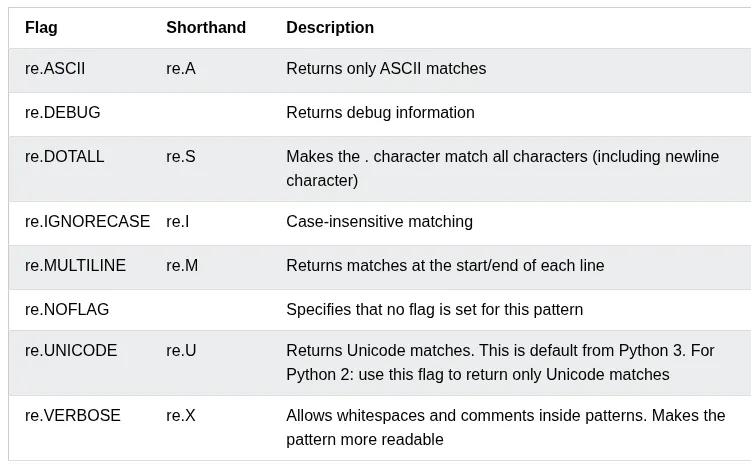
Flags
You can add flags to the pattern when using regular expressions.
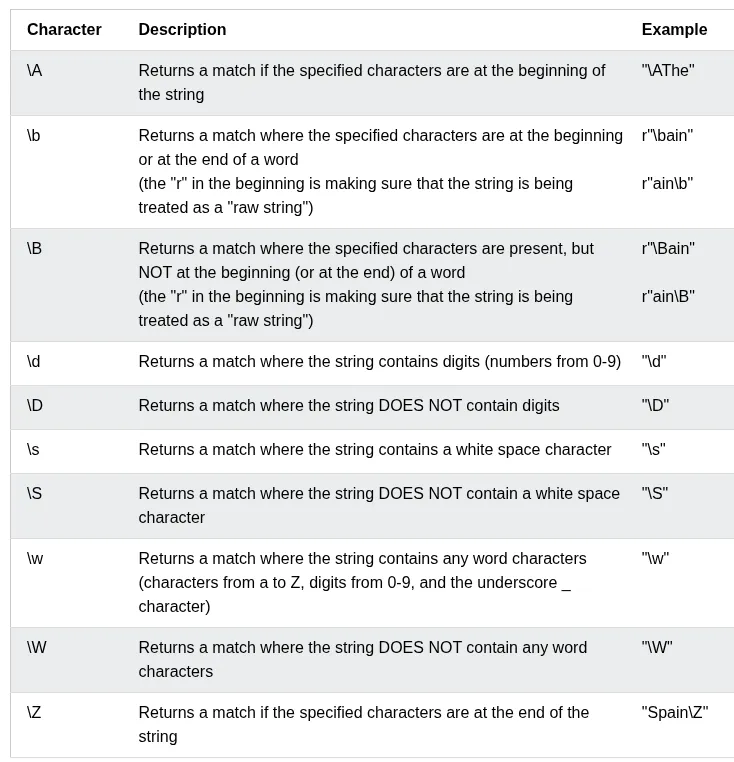
Special Sequences
A special sequence is a \ followed by one of the characters in the list below, and has a special mean:
Sets
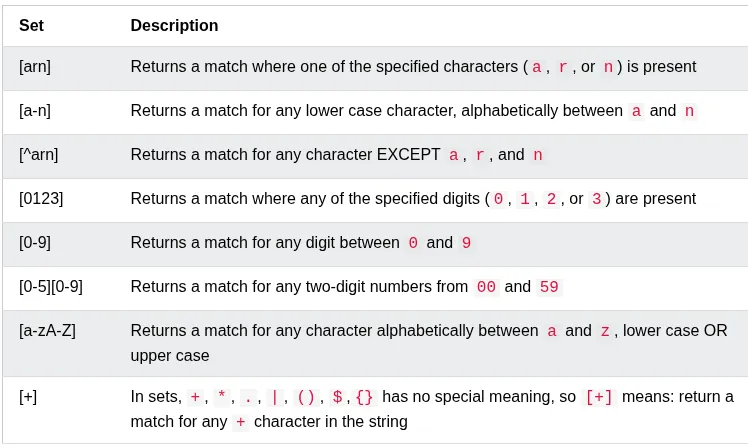
A set is a set of characters inside a pair of square brackets [] with a special meaning: